Showing posts with label Birds. Show all posts

Friday, November 2, 2007

* Children & Animal Extinction


* SPEAKING of EXTINCTION (and morbid children's books)--here's an ad from the BITS & PIECES gifts catalogue (Holiday 2007). How casually the young are indoctrined into an "everything's-all-right" attitude regarding the extinction of other species. The phrase "don't exist in the wild anymore" even intimates that these animals are still safe, in zoos or in rich people's backyards, perhaps. The Dodo on the cover is especially ironic in this regard, as perhaps the most famous species driven to extinction by humankind's own handiwork. But, "whatever": it's "Hours of dot-to-dot fun," all the same!

Thursday, September 20, 2007

Thursday, August 30, 2007

* RADIO RANT: Birds as Symbols

I only caught snippets of Michael Savage last night (8/29), but his discussion (or rather, rant, as usual) about the Senator Craig affair had somehow wandered to the bird calling in the background of the Senator's "I am not gay" press conference. Yes, it was a Red-winged Blackbird (its "cong-er-ee" call), as a caller or two told him; but Savage's immediate reaction was so typically Western, and by the way, so typically traditional-lit-crit: he asked, "What does the blackbird symbolize in literature?!" Yikes! The very subject, really, of my book-manuscript-at-the-press. I couldn't handle the ideational pain and fled to sports talk radio.

I suppose that at least one caller fed Savage the standard freshman-in-college answer—"the blackbird stands for death"—and that our good Doctor applied it "cleverly" to the Senator's doomed career. But again, how symptomatic of mainstream anthropocentric culture to see other species as "all about us," as if God had put other species here to remind humans of our own mortality. (Geez, was there ever a real, honest-to-goodness snake in the Garden of Eden?) There was a real, individual Red-winged Blackbird calling there, with as much "reason" and worth to do so as the human fellow frantically trying to save his political ass. A deconstructive reversal of foreground & background might be instructive here: "What's that stupid primate sputtering about while Mr. Blackbird sings his wonderful tune?"

Finally, the old "death" equation hardly works with the red-wing, anyway. The "black birds" traditionally demonized in Western folklore are the crow and raven, not even loosely related to the red-wing. Closer, ornithologically, are Wallace Steven's grackles, sometimes read by critics as symbols of death (though symbols of sheer mundanity, of "reality" itself, works better for me in the context of Stevens' corpus). In contrast, though—if I HAVE to talk "symbolism"—the red-wing has always suggested to me the jouissance of the new spring, a powerfully ebullient paean to (and epitome of) nature's general rejuvenation. But as a poem I wrote as a much younger fellow reminds me, even this is sheer homocentric projection:

        AFTER LORCA   (c. 1986; rev. 1992)

the red-winged blackbird
sings, but not to call his pied-brown mate
or a cattail congerie--
he sings to be singing: he sings

the red-winged blackbird
sings, but not for the ever-returning spring,
or other springs, gone by--
he sings to be singing: he sings

the red-winged blackbird
sings, not to recall in us some preter-
natural nature of things:
he sings

Tuesday, August 7, 2007

* BIG AFTERNOON (& Lost in the Wilderness)

Yesterday (8/6/07) I did a "Big Afternoon," in which the birder records as many species as she/he can in that time period (noon to dusk [or to midnight, for the hardy]). These are much more difficult than "Big Mornings": the two hours after sunrise are the climax of the day, bird-activity-wise, with the last hour or so before dusk usually a distant second, in my experience. By noon, the songfests & feasting are done, and the doldrum-heat of the afternoon is lethargic "kick-back" time for many species. Another contrast: on a Big Morning, I am also excited & invigorated at daybreak, along with the birds; with a Big Afternoon, I'm pretty tired & spent by that last daylight hour when the birds are once again quite active.

So I did pretty well, I suppose, to get 50 species, a record for me. Since I've rarely done Big Afternoons, for the reasons stated above, the record was easy to break. Plus, early August—after many species are done nesting and before they start migrating—might be one of the worst times for such a venture, next to the dead of winter. Worse yet, yesterday, there was a downpour from before noon until about 1:15, and so the enterprise began as a semi-fiasco (for me, not nature; and would end with another one).

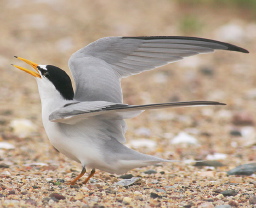
But I was rewarded, when it stopped raining, by having driven to a new spot for me, Schramm Park SRA, a state park between Lincoln & Omaha, just south of I-80. (But, characteristically, I took the back roads there, in hopes of more birds.) The highlight was a new species, the Least Tern: there was a pair of them, both diving in one of the ponds at the park entrance, making seemingly kamikaze splashes into the water, for small fish. These are small birds, after all, and ergo their name, "Least." Kinda sad, really, for a bird: some birds are GREAT (e.g., the Great Crested Flycatcher), but some are LESSER (e.g., the Lesser Yellowlegs) than "great," and some are last and LEAST! Well, at least there were two of them: "one good tern deserves another," I always say. (Bad birder-nerd humor.)

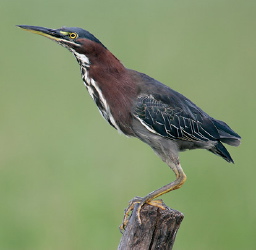
I saw my first Green Heron of the day at these ponds, too, and several later: I've grown fond of this particular species, which I never saw in SoDak—so small and, uh, skulking, I guess, compared to the Great Blue Heron. (I meant something more positive in connotation than skulking—and something less generic, more assertive, than secretive or furtive.) [(Same day, later add:) Maybe the word is just "sneaky"!?] Later, at a slough in Pioneers Park (Lincoln), I scanned the water—nothing . . . no, wait! There was a Green Heron there, frozen in place & time, its head and neck posed just above the horizontal, its eyes indicative of a mind bent on a fish-fetish monomania of a mission—all beyond the bounds of my human patience. (If I had a heron's patience, my life wouldn't be a collection of unfinished stories, essays, songs, web pages, and other projects grandly conceived but only half-executed.)

Across the highway was the Platte River itself: "I've heared talk o' this here Platte River"—and Nebraskans have good reason to boast of its avifauna. I watched a Bald Eagle fly overhead, the first I'd seen in several years. It was an adult, with the full white head. It was probably only 30 or 40 yards away, and I was struck again at how large this bird is, compared to its hawk-raptor relatives—though the Turkey Vulture is nearly as big. I also thought I saw a Piping Plover when I first arrived at the riverbank, on the closest sandbar, but it immediately ran to the other side of the bar, beyond my vision. But this may have been wishful thinking on my part since, Least Tern just recorded, this bird is now #1 on my species-to-get-for-my-Life-List. (And it still remains so—I didn't see it well enough to count it, especially as the first sighting of a new species.)

Farther down the river is the Platte River State Park, where I recorded a Yellow-billed Cuckoo, a species I've become much better acquainted with since moving to Nebraska. The song is curious—not a "coo-coo" at all, really: rather a repeated skoht—deep-pitched, gutteral, even fowl-like.

The afternoon's other highlights, in terms of variety of birds, were the two best birding venues in Lincoln, Pioneers Park and Wilderness Park. But in the latter place, a second fiasco occurred. Somewhere between marveling at the song of an Indigo Bunting and ogling a Blue-gray Gnatcatcher ogling me back, I got "turned around," direction-wise. Note that Wilderness Park is aptly named, a deep-wooded area several miles long, intersected by a few roads a mile apart. Well, I finally came to the bridge/road where my car was parked—it seemed like it had been a longer trail than usual—but wait: my car wasn't there, and it was actually a different bridge, and a different road. Damn: it was in the mid-90's, Missouri-humid, and I hadn't brought anything to drink, and I couldn't figure out/remember if this road was a mile north or a mile south of the road where my car was, and I began to panic, and I wondered how far it was (these are the boonies/outskirts of Lincoln) to a Mini-Mart phone to call a cab or something—and then I heard a Black-capped Chickadee—ah!—and wrote it down. I finally flagged down a biker who told me that I was on Old Cheney Rd, that my street—W Pioneers Blvd—was a mile north . . . I found a bottle of water in the car that I'd kept in there for months. It was hotter than hell, but still tasted good. In spite of "losing" an hour (approx. 6:00-7:00 pm), I still had the time and motivation to hit some dirt roads and WMAs (Wildlife Management Areas) northwest of Lincoln for a few more species. . . .

"Oh, Tom Gannon? Yeh, the irony: he died birdwatchin' down at Wilderness Park. Roasted to death, poor man. But at least he broke his Big Afternoon record that day, I hear."

= = = =

P.S.: Oh, yeh, I saw a Eurasian Collared-Dove in Elmwood, Nebraska. (Just caught a flash-glimpse, but the white under-tail feathers were distinctive.) I'm familiar with this bird, which has begun showing up in Rapid City (SoDak) the last few years, and I actually wonder why I haven't seen them in Lincoln yet.

Wednesday, August 1, 2007

* Of Computer Nerds & Birds

. . . a hobby fit only for little old ladies in tennis shoes.Another "nerd" tip from the desk—er, laptop—of TCG, for those of you who are both proud iPod owners and (sheepish?) birders.

"Sheepish"? You see, when I was growing up, anyway, birdwatching was the height of nerdsville, pictured in the popular media as a hobby fit only for little old ladies in tennis shoes. I'd slink around the alleys and woods and sloughs with my 7x35 K-Mart binoculars, hoping that people thought that I was merely a peeping Tom, or some other human category less socially ostracized than that of—BIRDWATCHER. Things have changed at least a bit, apparently: I just read the other day that ""[o]ne of every four Americans is a birdwatcher" (Birding Nebraska 144), but that stat is pure hyperbole, unless one includes (as this source does) those who take a nature walk at least "once or twice a year." (We real birders know that such people lack the requisite requirement, which is a veritable MANIA that cannot be eased by the occasional "nature excursion.") . . . I've just invested in a cheap (of course) spotting scope and cheap but humongous tripod—for those "pesky" gulls and other waterfowl often visible only at an extreme distance. I set it up in my apartment, to practice with it, looking out my patio window at distant trees, the moon, etc. Well, now, I'm sheepish about being seen using it for a far different reason. Yes, the irony: in this day and age, I don't want anyone thinking I'm a peeping Tom! . . . I imagine it now, one police officer saying to the other: "Ah, the perv has cleverly strewn his apartment with bird books. An interesting but transparent ruse. Take him away."

To the iPod and the "nerd" tip, finally. Buy one or both of the Stokes Field Guide to Bird Songs CD sets. (If you're in the Midwest/Great Plains like me, you'll want both the Eastern and Western sets.) Then transform them all to iTunes. (Or you can be selective, if jealous of hard-drive space: I omitted many birds that I'll never hear in the northern Great Plains—unless global warming gets on with it even more quickly.) Now, of course, sync your iPod with iTunes, and—voilà—you now have a great birding field-trip aid. If, like me, you hate waiting for hours after having heard a strange bird's song to check it out at home, via a recording or that paragraph-long description in a tome you'd never lug w/ you on the road, and your own faint memory and a bad transliteration that you scribbled down—wait no longer, dear friends! Simply whip out your iPod on the spot, find the two or three bird names/songs that your bird guide has suggested as most likely: [insert Christopher Walken imitation:] ah, that new species is yours, baby, and life is good!

If you want to match my compulsiveness—and don't we all?—you can also cut&paste a photo (readily found on the 'Net) of each species "into" its mp3 file as iTunes "album art." But, assuming that you have a bird guide per se, this is no doubt overkill. (But, ah, an iTunes/iPod digital BIRD GUIDE. I thought of it first! The standard bird-guide textual info can be put into the mp3 file's text fields, and the range map—also readily available on the 'Net—can be a second "album art." [Though I'm not sure the iPod handles multiple albumart yet.] You could even use specific mp3 text fields for personal info on date first seen, et al.)

Finally, and the final irony: I've never remembered to bring my iPod on my birding trips as of yet. As I've mentioned before, I hate the idea of a mini-stereo that I've got to attach or pocket somewhere; plus, I'd have to bring some "real" (bulky) headphones, since those earbud deals drive me to distraction. Hey, but I bet somebody else has thought of this idea, and has tried it and liked it. Or will try it. And maybe like it. I don't know. . . .

Friday, July 27, 2007

* John & Martha VIII

(There are several levelsl of irony here, too.)

* John & Martha VII

(Obviously—and intentionally—you can read this cartoon in a variety of ways.)

* ANDY of MAYBERRY

I just channel-surfed past The Andy Griffith Show, recalling my longtime judgment that it's the best TV sitcom ever. (Save yr "hayseed" jokes.) I've seen plenty of (reruns of) All in the Family, M.A.S.H., Seinfeld—and now I'm a big fan of Everybody Loves Raymond, having never followed the original run; but all the 70's thru even the 90's sitcoms seem dated, compared to the Everyperson/Everyplace comedy&realityland that was Mayberry. Of course, the first several seasons were the true masterpieces. The show already began to decline when "Barney" left, when "Goober" replaced "Gomer," when "Howard Sprague" and color TV showed up. And of course, there is not even a mention of an African-American, and the Native American is complete stereotypical myth when said race does appear in discourse (my transcription of crucial passages from the episode, "Aunt Bea's Medicine Man"). . . . But when Opie lets his baby birds go, and then laments the empty cage, and Andy says, "But don't the trees seem nice and full?"—all is forgiven.

Thursday, July 19, 2007

* John & Martha VI

À propos the Michael Vick dog-betting fiasco:

* RADIO RANT: Dog Eat Dog; Rich Wear Fur

The outrage by the talking heads on sports talk radio and cable news regarding the Michael Vick dog-fighting scandal was understandably vehement—but so self-righteous. That is, all these people can be "right," but for the wrong reasons. "How inhumane! I'm a dog lover! All Americans love dogs!" But when the occasional "nut" called in suggesting that shooting deer and pheasants is no less barbaric, such discourse was dismissed as beyond the pale. Worst has been the pompous&supercilious attitude of ESPN Radio's Colin Cowherd, whose elitist/urbanite biases distinguished themselves: pit-bull fighting is a despicable sport practiced especially by the poor, the rural, and the Southern (and the—shshshsh—black). You're so right, Colin. You city folk are immune to such first-hand visceral cruelty, with enough money to distance yourself from the inhumane (such an ironic term) factory farming that provides you with your veal parmesan and chicken Kiev, while your pasty-skinned lazy Euro-jet-trash-of-a-wife can't decide whether to wear a dead fox or mink, to cover her pastiness.

All this outrage is also completely anthropocentric: that is, it's all about us humans—including "man's best friend." There would certainly have been less outrage if Vick had been involved in cockfighting. Or how about terrapin matches? (Yeh, probably very lengthy affairs.) Or cricket bouts, to the death?! My point is that, if humankind has an innate biophilia (love of all life), it's still quite mammalo-centric: we love the animals that remind us most of us, that have fur, and cuddly babies . . . and maybe milk that we can feed to our own babies. And so, following my niece & nephew around the zoo gift shop last week, I wasn't surprised to see that nearly all of the stuffed animals were mammals. The few birds seemed unnatural and stiff and "distant"; the reptiles and insects were intentionally rubbery and "alien."

In fact, though my book-in-manuscript spends pages on end explaining the poets' age-old obsession with birds, I'm still rather surprised when people actually grow attached to them as pets. (I refuse to do so, being against caged birds in general.) But my wife, for one, treats her budgie as her best friend, though it shits on her shoulder all the time and bites the hell out of me when I show up. (Well, at least we and birds are both vertebrates: so, yeh, birds still kick ass on locusts as pets.) But I wonder if the average human mourns as much when his/her lovebird flies out the window in the middle of winter and never returns, compared to when old Fido gets run over by the neighbor's car. Birds, I guess, are somewhere between our mammal-compatriot dogs and cats—and that goldfish whose tombstone is the toilet-bowl lid. ("Mom! Where's Jimmy? He's not in his bowl!")

I've wandered far from Michael Vick to illustrate how problematic "animal rights" is. I don't even like that term ("rights" is a human legal construct, after all), preferring Lawrence Buell's phrase, "nonanthropocentric ethics." But that won't fit into a talking point or on a bumper sticker.

[Added same night:] Wow: it's pretty fascinating to learn, then, that Atlanta Falcons owner Arthur Blank's reaction to his quarterback's legal problems has been belated because the fellow has been on vacation. In Africa. On safari.

Wednesday, July 11, 2007

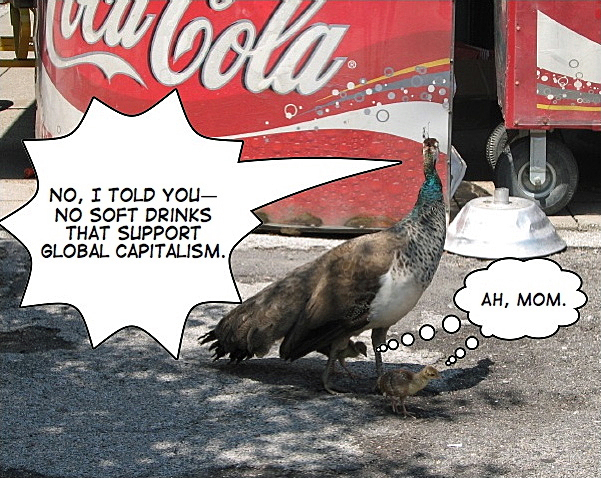
* Peahen Politics

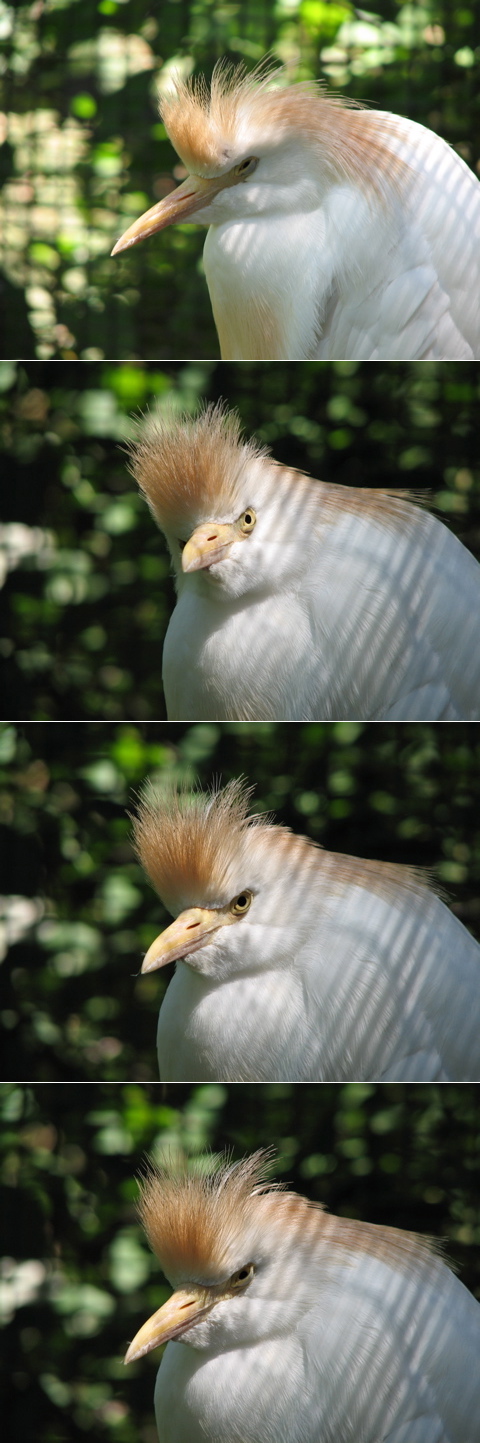
* Portrait of the Artist as a Pissed Bird

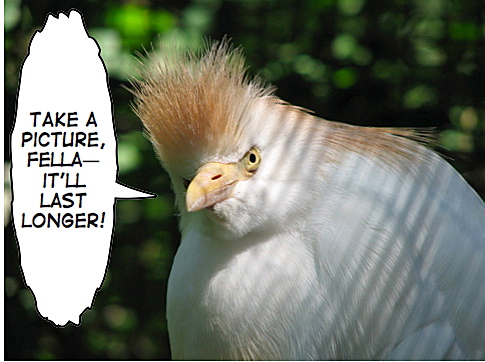
This Cattle Egret was a highlight at the Folsom Children's Zoo—a person upon whom I could project my own misanthropic mood. . . . Through the series of four picts, he/she seems to get more and more indignant, to the point of a slow burn:

* EGRETude #1 (Bad Vibes at the FCZoo)

Sunday, July 1, 2007

* John & Martha V

My wife just told me over the phone that my natural disposition is "mean and hurtful." I think it "merely" stems from being an oldest child, with an instinct to kick the younger siblings out of the nest? And yes, there's a definite attraction/similarity to Michael Savage here: as much as I detest his politics/worldview in toto, I no doubt still relish his "mean & hurtful" tone?!

Friday, June 29, 2007

* John & Martha IV; Quitting Smoking

Maybe this is only funny to me because I just quit smoking myself (16 days, 11 hours, & 31 minutes ago):Quitting smoking partly—no, mostly—explains why I've been on a lot of outdoors excursions recently; the most dangerous place for me right now is my formerly smoke-filled (& still smoke-stained) apartment. Car trips are my current salvation.

* Pioneering New Frontiers—with Empty Beer Cans

"Pioneering New Frontiers" is the U of Nebraska's "new" (a few years old now) PR "slogan." And it certainly well represents an ongoing colonialist ideology that still permeates this state in terms of both place names and—I assume—good ol' boy attitudes, be they conscious or unconscious. As I've travelled the back dirt roads around Lincoln this summer in search of birds, the names of the lakes and SRAs (State Recreational Areas) have struck me as inordinately symptomatic: places like Stagecoach, and Wagon Train, and Conestoga. (As I drag my binoculars out of the car upon my arrival at one of these venues, I half-expect Hoss Cartwright or Rowdy Yates to show up on a fast horse and ask me, "Boy. [Dramatic pause.] You from around these parts?") Then there are the apparent acknowledgements to Native Americana, as in the names of Pawnee Lake/SRA and Indian Cave State Park. But for some reason, I keep hearing in my mind's ear "Indian Joe State Park" for the latter, and feel the flash-of-a-moment hope that Tom & Becky are safe from that savage ne'er-do-well's dastardly doings. (In other words, there's something exotically sinister in the connotations of the very phrase "Indian Cave.") At last, such names—"in these here parts"—sound so much like guilty elegies, half-hearted half-tributes to a race long gone. (And—well—"good riddance to 'em!" Examine a state map of Nebraska for Indian reservations to see how well the Natives were gotten rid of—in "these parts.")

Thank the Lord, then, that the colonials are taking good care of the good ol' Nebraska land, what with all the nature set-asides and such. (I keep reverting here to redneck idioms, for some reason.) Every SRA & state park has a large sign at every entrance, "No alcohol consumption allowed." But I swear that I've seen more empty beer cans and broken beer bottles in such places than I have Red-winged Blackbirds. (Hint: these are very common birds "in these parts"!) Seriously, I guess the problem is state funding for enforcement; the staffing of even the more frequented state parks seems really insufficient, and I'd assume, too, that conservation is hardly high on the agenda of those at the State Capitol, proud though they be of the nesting pair of Peregrines atop that building.

Wednesday, June 27, 2007

A Word from One of My Sponsors (not "AdSense"; rather "MadSense" or "RadSense"):

MeadowlarkSponsor